
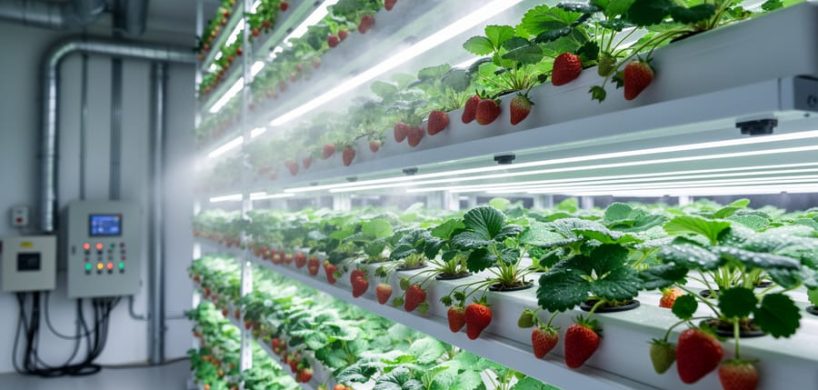
Vertical farming is a method of growing crops in stacked layers, usually indoors, using controlled lighting, climate, and nutrient delivery instead of open fields and natural sunlight. Leafy greens, herbs, and strawberries are common crops, grown in systems like hydroponics, aeroponics, and aquaponics that feed plants through water or mist rather than soil.
Why does it matter? Because the same technology that lets a warehouse or shipping container act as a farm also changes the environmental math of food production. Recirculating water systems can cut water use dramatically compared with field irrigation, and stacking crops vertically produces far more food per square foot of land. Growing in a sealed environment also reduces the need for pesticides and limits fertilizer runoff into waterways. Place these farms near cities, and food travels fewer miles from harvest to plate.
This article explains how the technology works, where it’s being used, and what it can realistically deliver. It also looks squarely at the trade-offs, including energy demand, because an honest picture is the most useful one.
What Vertical Farming Means in Plain Language
Vertical farming is a way of growing food in stacked layers, usually indoors, where growers control light, water, temperature, and nutrients. Instead of spreading crops across acres of soil, a vertical farm grows upward, using shelves, towers, or racks to multiply growing space within a small footprint.
It differs from field farming in a few clear ways. A field depends on weather, seasons, and soil conditions. A conventional greenhouse protects crops from the elements and extends the season, but it typically still uses a single level of plants and often relies on soil and outdoor conditions. A vertical farm takes control further, managing nearly every growing condition inside a sealed space. If you want a deeper walkthrough, our guide on how vertical farming works covers the process step by step.
A few core terms come up again and again, so here is a quick glossary:
- Vertical farming
- Growing crops in stacked layers rather than across a wide, flat field.
- Controlled-environment agriculture
- Farming inside a space where light, temperature, humidity, and nutrients are carefully managed, much like setting the thermostat in your home.
- Hydroponics
- Growing plants in nutrient-rich water instead of soil, so roots get exactly what they need.
- LED grow lights
- Energy-efficient lamps tuned to the colors of light plants use most for growth.
- Closed-loop irrigation
- A system that captures, filters, and reuses water instead of letting it drain away.
It helps to see vertical farming as one tool among many in a diverse food system. Field farmers grow grains, orchards, and staple crops at a scale no indoor farm can match. Vertical farms shine with leafy greens, herbs, and other delicate produce, especially near cities. The two approaches complement each other, and together they make our food supply more resilient.
How Vertical Farms Work: The Technology Behind the Savings
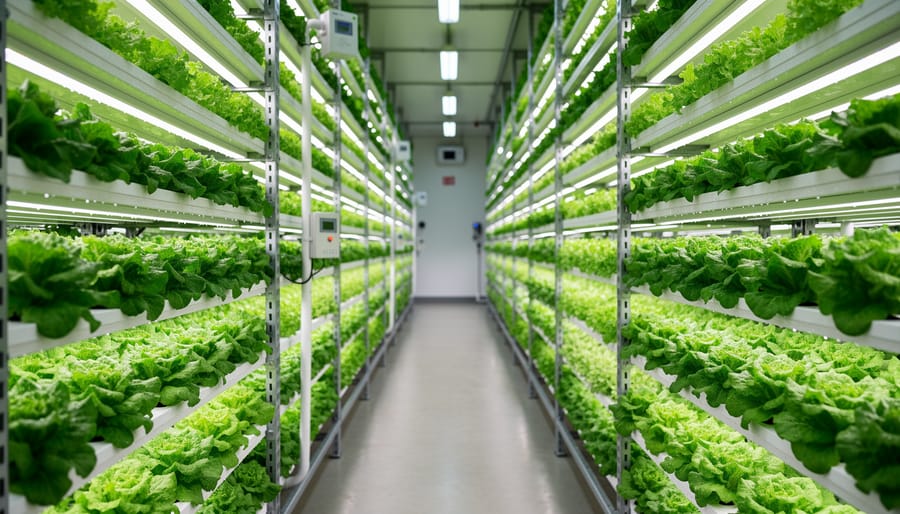
Hydroponics and Recirculating Water Systems
In a hydroponic system, plants grow without soil. Their roots sit in, or are misted with, water that carries dissolved nutrients such as nitrogen, potassium, and calcium. Instead of the plant searching through soil for what it needs, the farm delivers a precise mix straight to the roots.
The real water savings come from what happens next. In a field, much of the irrigation water is lost to runoff, soaks past the root zone, or evaporates before plants can use it. In a vertical farm, the growing space is enclosed, so water that isn’t absorbed drains back into a reservoir. There it is filtered, tested, topped up with nutrients, and sent around again.
Sensors keep the nutrient balance and pH in range, so the same water can serve crop after crop. Moisture that plants release into the air can also be captured by dehumidifiers and returned to the system. How much water a farm saves depends on the crop and the design, but the closed loop is the reason it can use far less than open-field irrigation.
LED Lighting and Climate Control
Plants use light selectively, and LEDs let growers take advantage of that. Chlorophyll responds most strongly to red and blue wavelengths, so vertical farms can tune the spectrum for each crop and growth stage, boosting leaf growth in one phase and encouraging compact, flavorful plants in another. Because LEDs run cool, they can sit just inches from the plants without scorching them, which is what makes stacking layers practical.
Light is only part of the picture. Sensors guide the farm’s climate controls to hold temperature, humidity, and airflow in a narrow range. Steady air movement strengthens stems and prevents damp pockets where mold could form, while balanced humidity helps plants take up water and nutrients efficiently.
There’s an honest trade-off here. Lighting is the largest energy draw in most vertical farms, and cooling adds to it. Efficiency gains in LED technology are steadily reducing that demand, and the energy source matters just as much. We’ll look at that more closely in the section on trade-offs.
Machine Learning and Sensor Monitoring
Sensors are the quiet workhorses of a vertical farm. Small probes in the water track pH, electrical conductivity (a measure of how much dissolved nutrient the plants have available), and temperature, while cameras and environmental sensors watch humidity, airflow, and light levels around the crops. Together they produce a steady stream of data about what each growing layer needs.
Machine learning turns that stream into decisions. By comparing current readings with patterns from past harvests, software can spot trends, such as a nutrient mix drifting off target or leaves showing early signs of stress, before a person would notice. The system can then adjust dosing, lighting, or climate settings in small, precise steps.
The sustainability payoff is practical. Feeding plants only what they need means less fertilizer, less water, and less electricity going to waste. Catching problems early also protects yields, so fewer crops are lost along the way. Results depend on the farm’s design and crop, but this kind of fine-tuning is a big reason controlled-environment growing can be so resource-efficient.
The Environmental Benefits of Vertical Farming
Using Far Less Water
In a conventional field, much of the irrigation water never reaches the plant. It evaporates from the soil surface, drains below the root zone, or runs off the edges of the field. Vertical farms avoid most of that loss by using closed-loop hydroponic systems. Water is delivered straight to the roots, and whatever the plants don’t take up is captured, filtered, and sent back through the system. Humidity from the growing room can even be condensed and returned as water.
The result can be a sharp drop in consumption compared with open-field irrigation, especially for leafy greens and herbs. Exact savings vary with the crop, the system design, and the climate being controlled, so treat any single percentage with caution.
This matters most where water is scarce. Arid regions, drought-prone areas, and cities with strained supplies can grow fresh produce without drawing heavily on shared water sources.
Producing More Food on Less Land
Vertical farms grow crops in stacked layers, so each square foot of floor space does the work of many square feet of field. That design delivers a much higher yield per area, though the exact gain depends on the crop, the number of layers, and how the farm is run.
This matters because agriculture is a major driver of land conversion. When we can grow more food on a smaller footprint, there is less pressure to clear forests and grasslands for new farmland, and those ecosystems keep storing carbon and sheltering wildlife.
Vertical farms also don’t need fertile soil or open acreage. They can sit on rooftops, inside warehouses, or on previously developed sites that would otherwise go unused. That flexibility puts food production closer to the people who eat it.
Cutting Pesticide Use and Nutrient Runoff
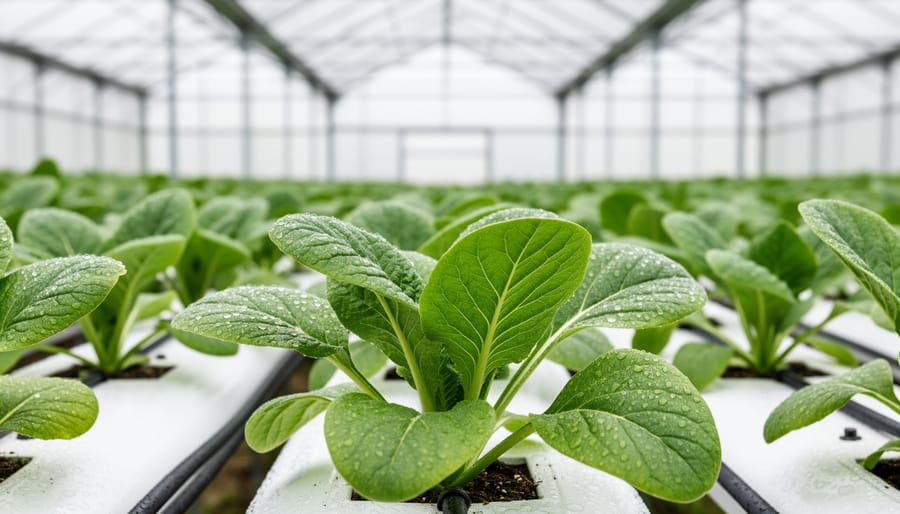
Because vertical farms are enclosed, they can keep pests out in the first place. Sealed rooms, filtered air, controlled entry points and clean growing media mean many operations rely on prevention rather than spraying. That often lets growers cut back on pesticides or skip them entirely, which also means fewer chemical residues to manage.
Nutrients stay contained, too. In a conventional field, fertilizer that plants don’t absorb can wash into streams and groundwater, and agencies note that practices to reduce nutrient and pesticide runoff are central to protecting water quality. In a hydroponic system, the nutrient solution circulates in a closed loop, so excess is captured and reused instead of escaping.
Results still depend on farm design, and spent nutrient solution needs proper handling, but the contained approach offers a real advantage for nearby waterways.
Shorter Supply Chains and Less Food Waste
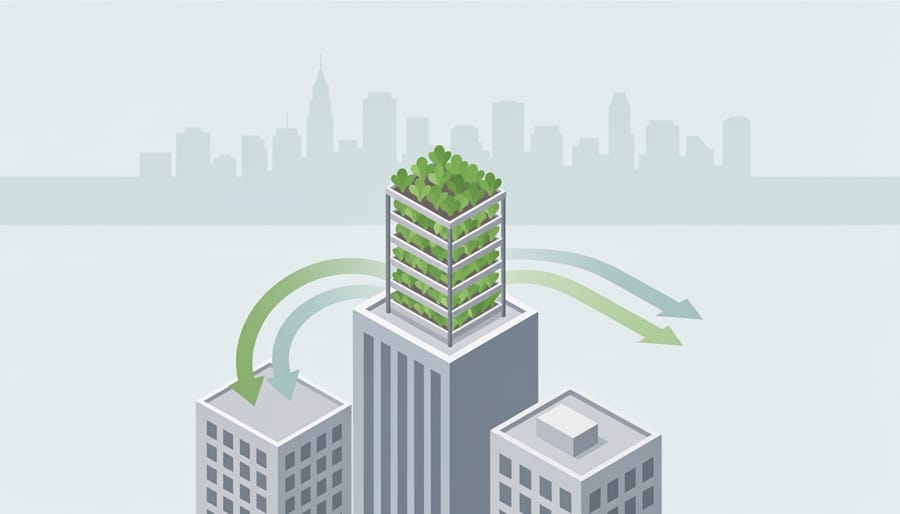
Most fresh produce travels a long way before it reaches your plate. Leafy greens grown in distant fields are often harvested early, packed in protective materials, and trucked or flown for days. Every extra mile adds fuel use, packaging, and a little more time for the crop to wilt or spoil.
Vertical farms can sit in or near the cities they serve, sometimes in a warehouse a few miles from the grocery store. Shorter trips mean fresher produce, less packaging, and fewer losses along the way. Because plants are harvested closer to the moment of sale, more of what’s grown actually gets eaten.
Production is also steady all year. Indoor crops don’t depend on rainfall, frost, or heat waves, so supply holds up when extreme weather disrupts outdoor harvests. That reliability supports local food security, especially in places where fresh produce is hard to come by.
Energy Use and Honest Trade-Offs
Vertical farms use a lot of electricity. Since there’s no sunlight indoors, LED lights supply the energy plants need for growth, and climate control systems add to the load by managing temperature, humidity, and airflow around the clock. That’s the main trade-off, and it deserves a plain acknowledgment.
The gap is narrowing, though. LED technology keeps getting more efficient, producing more usable light per unit of electricity, and better insulation and smarter sensor-driven controls trim wasted energy. Facilities can also tune light spectrums and schedules to each crop rather than running everything at full power.
The biggest lever is where the electricity comes from. A farm running on solar, wind, or other renewable power has a very different footprint than one drawing from a coal-heavy grid. So the full environmental picture depends on the energy mix, and the strongest vertical farms treat clean power as part of the design from the start.
Where Vertical Farming Is Used Today
Vertical farming works best with crops that are compact, fast-growing, and quick to harvest. That is why leafy greens such as lettuce, kale, and arugula dominate the industry, followed by herbs like basil and mint, and nutrient-dense microgreens. A few growers are also experimenting with select berries, though larger crops like grains and root vegetables remain better suited to open fields.
Where these farms operate matters just as much as what they grow. Because they don’t depend on soil or seasons, they can be set up in places where traditional growing is difficult. That flexibility is a big reason urban agriculture has grown alongside the technology, and it ties directly to vertical urban agriculture, which brings stacked growing systems into the heart of cities.
Common applications and settings include:
- Urban rooftop farms that turn unused building space into productive growing areas
- Repurposed warehouses and shipping containers converted into climate-controlled farms
- Regions with limited arable land or water, including arid climates
- Grocery and restaurant supply chains that want consistent, locally grown produce
- Community food programs aiming to improve fresh food access in food deserts
Commercial partnerships are also shaping how the technology spreads. Retailers, food service companies, and property developers increasingly team up with growers to place farms close to the people who eat the food, which cuts transport time and keeps produce fresher on arrival.
This is where Home Grown Farm fits in. We grow ready-to-use produce for customers who want fresh, sustainably grown greens and herbs without the long supply chain. For businesses planning a future vertical farm, we also offer guidance on choosing crops, systems, and locations that match their goals. The aim is simple: make advanced growing technology practical, approachable, and genuinely useful for the communities it serves.
Vertical Farming and Traditional Agriculture: Working Together
Vertical farming works best as a partner to field-based agriculture, not a replacement for it. Open fields remain the most practical home for staple crops like wheat, corn, rice, and soybeans, which need wide acreage and benefit from natural sunlight and rainfall. Vertical farms shine with fast-growing, high-value, delicate crops such as leafy greens, herbs, and microgreens, which can be harvested often and sold close to where people live.
Each approach also borrows from the other. Growers who care for soil life are finding useful ideas in indoor systems, and the reverse is true too. If you’re curious how that crossover plays out, the story of natural farming meets hydroponics shows how time-tested biological practices can inform controlled-environment growing.
There are real challenges worth naming. Building a vertical farm takes significant upfront capital for lighting, climate control, and sensors, and operating costs depend heavily on energy prices. Crop variety is still limited, since tall, heavy, or slow-maturing plants don’t pencil out indoors. Those constraints are exactly why a balanced food system makes sense.
The outlook is encouraging, though. As LED efficiency improves, renewable power gets cheaper, and machine learning sharpens day-to-day operations, the costs keep shifting in the right direction. Farmers working the land and teams working under grow lights are tackling the same goal from different angles: feeding people well while treating water, soil, and energy with care. Together, they give communities more ways to stay resilient when weather, supply chains, or land availability throw a curveball.
Common Questions About Vertical Farming and the Environment
Does vertical farming really use less water?
Generally, yes. Because vertical farms recirculate irrigation water instead of letting it run off or evaporate, they can use far less than open-field growing. The exact savings depend on the crop, the system design, and how the farm manages humidity.
Is vertical-farmed produce pesticide-free?
Not automatically, but enclosed, controlled spaces keep pest pressure low, so many farms need little or no chemical protection. Growers often rely on clean rooms, screening, and monitoring instead. If it matters to you, check the farm’s own growing practices.
Does vertical farming use more energy than field farming?
Often it does, mainly because of LED lighting and climate control, since fields get free sunlight. Efficient lighting and renewable power can narrow that gap, so the energy source matters as much as the technology.
What crops grow best indoors?
Leafy greens, herbs, and microgreens do especially well, as they are compact, fast-growing, and need little structural support. Select berries and some vegetables are also being tested, while staples like wheat and corn still make more sense in fields.
You might also wonder whether vertical farms can feed the world on their own. Most experts see them as one piece of a varied food system, strongest where land, water, or fresh local produce are in short supply. Traditional agriculture will keep supplying the calories we depend on, and vertical farming adds resilience and efficiency alongside it.
Vertical farming offers a practical way to grow food with far less water, less land, and fewer chemicals, while keeping production closer to the people who eat it. Recirculating systems cut irrigation demand, stacked layers raise yield per square foot, enclosed spaces limit pesticide use and nutrient runoff, and shorter supply chains reduce transport and spoilage. Energy use remains the honest trade-off, but efficient LEDs and renewable power are steadily narrowing that gap.
None of this means field farming is on its way out. The strongest food systems will pair the proven strengths of traditional agriculture with the precision of controlled-environment growing, each doing what it does best.
As the technology matures, Home Grown Farm is committed to helping build that balance, delivering fresh, sustainably grown produce today and supporting the vertical farms that will make our food supply more resilient tomorrow.