
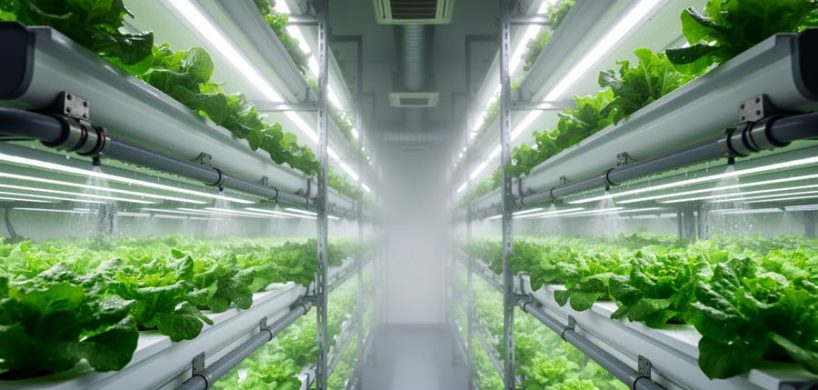
Vertical farming is the practice of growing crops in vertically stacked layers within controlled indoor environments, using advanced technologies like LED lighting, hydroponics, and climate control systems to optimize plant growth without soil or natural sunlight. This agricultural innovation represents a fundamental shift in how we produce food, turning warehouses, shipping containers, and urban buildings into year-round production facilities that can operate anywhere, regardless of climate or geography.
As global populations concentrate in cities and arable land becomes increasingly scarce, vertical farming offers a practical solution to growing fresh produce closer to where people actually live. The approach eliminates many limitations of conventional agriculture. Crops grow faster with precise nutrient delivery, water use drops by up to 95% through recirculation systems, and pesticides become largely unnecessary in sealed environments. A single acre of vertical farm can yield the equivalent of 10 to 20 traditional acres, depending on the crop.
The technology has matured significantly by 2026. What began as experimental facilities now includes commercial operations supplying major grocery chains with leafy greens, herbs, and strawberries. Innovations in energy-efficient LED systems, automated harvesting, and AI-driven environmental controls have addressed early concerns about operational costs and scalability.
This article explains how vertical farming works, the different systems and technologies involved, and the real-world applications transforming food production. You’ll understand both the engineering principles behind these farms and why they’re becoming essential infrastructure for sustainable food security.
Defining Vertical Farming
Vertical farming represents a revolutionary agricultural method where crops grow in vertically stacked layers inside controlled indoor spaces, typically within buildings or specially designed structures. Unlike traditional farming that spreads horizontally across open fields, vertical farms maximize limited space by building upward, creating multiple growing levels within a single footprint. This approach allows food production to occur year-round, independent of weather patterns, seasonal changes, or geographic constraints that limit conventional agriculture.
The practice centers on creating precisely controlled environments where every growth factor, temperature, humidity, light, nutrients, and airflow, can be optimized for specific crops. These indoor facilities eliminate the unpredictability that outdoor farmers face, from droughts and floods to pest infestations and temperature extremes.
- Controlled Environment Agriculture (CEA)
- Agricultural production within enclosed structures where environmental conditions are regulated by technology rather than dictated by nature. This approach enables consistent, year-round harvests regardless of external climate.
- Vertical Stacking
- The arrangement of multiple growing tiers or shelves one above another within a facility, multiplying the productive area without expanding horizontal space. A single warehouse can house 10 or more growing levels.
- Indoor Farming
- Crop cultivation conducted entirely within buildings or enclosed structures, protected from external weather and pests. These facilities range from repurposed warehouses to purpose-built agricultural towers.
- Soilless Cultivation
- Growing methods that deliver water and nutrients directly to plant roots without traditional soil, including hydroponic, aeroponic, and aquaponic systems. This eliminates soil-borne diseases and reduces water usage dramatically.
What separates vertical farming from conventional greenhouses is the complete independence from natural sunlight and soil. While greenhouses still rely on sun exposure and often use ground-based growing, vertical farms operate with artificial lighting and soilless systems, enabling placement anywhere, from urban warehouses to underground facilities, without regard for climate zones or arable land availability.
How Vertical Farming Works
Controlled Environment Systems
Vertical farms function as precision-engineered ecosystems where environmental conditions remain stable regardless of external weather patterns. Unlike traditional agriculture, which depends on seasonal climate variations, these facilities maintain exact specifications for temperature, humidity, light intensity, and atmospheric composition throughout the year.
Temperature control systems keep growing spaces within narrow ranges optimized for specific crops, typically between 65-75°F for leafy greens. Advanced HVAC equipment responds to real-time sensor data, adjusting heating or cooling within minutes to prevent stress that could slow growth or reduce yields. This consistency eliminates the production gaps that plague conventional farms during extreme weather events.
Humidity regulation works in tandem with temperature control, maintaining moisture levels that prevent fungal diseases while ensuring plants can efficiently transpire and absorb nutrients. Sensors monitor relative humidity continuously, triggering dehumidification or misting systems to hold conditions in the ideal 50-70% range for most crops.
CO2 enrichment provides another performance lever. By elevating carbon dioxide levels slightly above atmospheric concentration, often to 800-1200 ppm, vertical farms accelerate photosynthesis rates and boost growth speeds by 20-30% compared to ambient conditions.
These integrated systems create a perpetual growing season where crops mature faster, produce higher yields, and maintain consistent quality. A head of lettuce that takes 60 days in a field can be ready for harvest in 30 days under optimized vertical farm conditions, with no weather-related crop losses.
Soilless Growing Methods
Vertical farming replaces traditional soil with precisely engineered growing systems that deliver water and nutrients directly to plant roots. These soilless methods give growers exact control over what plants receive, when they receive it, and in what concentrations, eliminating the inconsistencies and limitations of soil-based cultivation.
Three primary approaches dominate vertical farming operations:
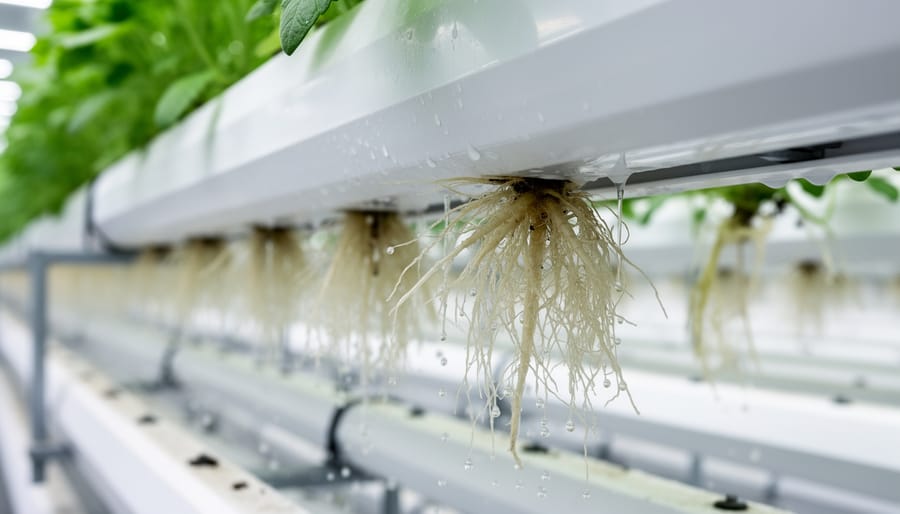
- Hydroponics suspends plant roots in nutrient-enriched water solutions, often using inert growing media like rockwool or clay pellets for physical support
- Aeroponics mists plant roots with nutrient solutions while they hang in air, maximizing oxygen exposure and minimizing water usage
- Aquaponics combines fish farming with plant cultivation, where fish waste provides natural nutrients for plants while plants filter water for fish
Hydroponic systems remain the most widely adopted in commercial vertical farms because they balance efficiency with manageable complexity. Nutrient Film Technique (NFT) setups circulate a thin film of solution past roots, while Deep Water Culture (DWC) submerges roots in oxygenated reservoirs. Both approaches let operators adjust nutrient formulas in real time based on plant growth stages.
Aeroponic systems deliver impressive results but demand more sophisticated monitoring. The constant misting creates ideal conditions for rapid root development and uses 70% less water than hydroponics, though any equipment failure quickly threatens crops since roots have no buffer of soil or standing water.
Aquaponic systems appeal to operations targeting sustainability credentials, creating a closed-loop ecosystem that produces both fish and vegetables. The trade-off is complexity: balancing the needs of two organisms requires more expertise than optimizing nutrients for plants alone.
LED Lighting and Energy Management
LED grow lights serve as the sun replacement in vertical farming, delivering precise wavelengths that plants need for photosynthesis. Unlike traditional high-pressure sodium or fluorescent lights, modern LEDs can be tuned to emit specific color spectrums, primarily red and blue wavelengths that chlorophyll absorbs most efficiently. Red light promotes flowering and fruiting, while blue light encourages vegetative growth and compact, sturdy plants.
This targeted approach eliminates wasted energy on wavelengths plants don’t use. Vertical farms typically run lights for 12 to 18 hours daily depending on crop requirements, making efficiency critical to profitability.
Energy management goes beyond choosing efficient bulbs. Advanced vertical farms use sensors and automation to adjust light intensity throughout the day, mimicking natural sunrise and sunset patterns that can improve crop quality. Some operations program “light recipes”, customized schedules and spectrum combinations for specific crops at different growth stages.
The largest operational cost in most vertical farms is electricity, with lighting accounting for 40 to 60 percent of total energy consumption. Many facilities offset this through renewable energy sources like rooftop solar panels or purchase agreements with wind farms. Others optimize timing, running lights during off-peak hours when electricity rates drop.
Heat management matters too. While LEDs generate less heat than older lighting technologies, thousands of fixtures still produce significant warmth. Efficient farms capture and redirect this heat, sometimes using it to warm buildings in winter, reducing the overall energy footprint.
Types and Components of Vertical Farming Systems
Building-Based Vertical Farms
Vertical farming infrastructure takes three primary forms, each suited to different scales and operational goals. Warehouse conversions represent the most common entry point, transforming vacant industrial buildings into productive agricultural space. These facilities capitalize on existing structures with high ceilings and open floor plans, reducing initial capital requirements while revitalizing urban areas. Developers typically retrofit warehouses with climate control systems, growing racks, and specialized electrical infrastructure to support LED arrays.
Purpose-built vertical farms offer optimized design from the ground up. These facilities incorporate architectural features like natural light integration, advanced HVAC systems, and workflow-efficient layouts that maximize productivity per square foot. Though more expensive initially, purpose-built structures deliver superior energy efficiency and allow precise control over every environmental variable.
Shipping container farms provide the most flexible and scalable option. A single 40-foot container can produce crops equivalent to several acres of traditional farmland. These modular units work well for restaurants seeking hyper-local ingredients, remote communities with limited agricultural access, or businesses testing vertical farming before larger investments. Multiple containers can be stacked and connected as operations expand.
Core Technology Components
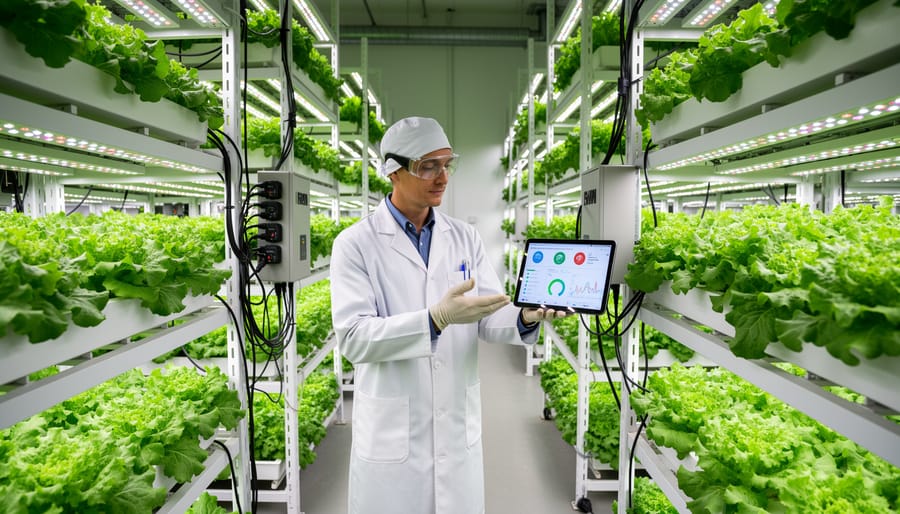
Modern vertical farms function as precision agriculture environments through integrated technology systems that continuously monitor and adjust growing conditions. Environmental sensors track temperature, humidity, CO2 concentration, and light intensity at multiple points throughout the facility, transmitting real-time data to central control systems. These sensors enable growers to detect micro-variations in climate and respond before conditions affect plant health.
Automated climate control equipment maintains optimal growing parameters by adjusting HVAC systems, humidifiers, dehumidifiers, and ventilation based on sensor feedback. Nutrient delivery systems automate the mixing and distribution of fertilizer solutions in hydroponic and aeroponic setups, maintaining precise pH levels and nutrient concentrations for each crop variety. Irrigation controllers adjust watering schedules based on plant growth stages and environmental conditions, eliminating waste while ensuring plants receive exactly what they need.
Machine learning applications analyze the continuous stream of sensor data to identify patterns and predict optimal growing parameters. These systems learn from each growth cycle, refining recommendations for light schedules, temperature ranges, and nutrient formulations specific to each crop. Computer vision technology monitors plant development, detecting early signs of stress, disease, or nutrient deficiencies that human observers might miss.
Robotic systems handle repetitive tasks like seeding, transplanting, and harvesting with consistency and speed. Advanced facilities integrate these components through centralized software platforms that provide growers with complete operational visibility, from energy consumption to projected harvest dates, transforming vertical farming into a data-driven enterprise where every variable affecting plant growth is measured, controlled, and continuously improved.
Scalable Configurations
Modular design principles enable vertical farms to expand incrementally rather than requiring massive upfront investments in infrastructure. These systems use standardized growing towers, climate control units, and automation modules that snap together like building blocks. A startup might begin with a single 320-square-foot shipping container producing 3,000 pounds of greens annually, then add identical units as demand grows.
Commercial operations take this further by stacking multiple modules vertically or arranging them in warehouse configurations. Each module operates independently with its own sensors and controls, allowing farmers to test different crops or growing conditions simultaneously. This flexibility means a 10,000-square-foot facility can scale to 50,000 square feet without redesigning core systems, just replicating proven modules and connecting them to centralized monitoring platforms that manage the entire operation.
Uses and Applications of Vertical Farming
Urban Food Production
Vertical farms strategically positioned in urban centers transform underutilized buildings and spaces into productive agricultural facilities that supply fresh produce within miles of consumers. This proximity eliminates the typical 1,500-mile journey food travels from farm to table, delivering leafy greens and herbs to restaurants and retailers within hours of harvest rather than days.
Cities gain resilience against supply chain disruptions when local vertical farms provide consistent year-round production independent of weather events or seasonal limitations. A single vertical farm occupying one acre of urban real estate can produce yields equivalent to 10-30 acres of conventional farmland, making it feasible to grow substantial quantities of food where land is scarce and expensive.
The model particularly benefits food deserts, urban neighborhoods lacking access to fresh produce, by establishing growing operations in previously underserved areas. Restaurants and grocery stores receive crops at peak freshness since harvest-to-shelf time shrinks from weeks to mere hours, extending shelf life and reducing food waste throughout the distribution chain. Some vertical farms partner directly with community organizations to provide affordable fresh vegetables to local residents, strengthening neighborhood food access while creating green jobs in urban areas.
Resource Conservation
Vertical farming delivers substantial resource savings that address critical environmental challenges. By circulating nutrient-rich water directly to plant roots in closed-loop systems, vertical farms use 70-95% less water than conventional soil-based agriculture. This drastic reduction stems from eliminating irrigation runoff and ground absorption, with most systems recapturing and reusing moisture released through plant transpiration.
The controlled indoor environment removes the need for chemical pesticides entirely. Without exposure to outdoor pests, diseases, and weeds, crops grow clean without synthetic interventions that contaminate soil and waterways in traditional farming. Climate control systems maintain conditions that naturally suppress pest populations while promoting vigorous plant health.
Space efficiency represents another transformative advantage. Vertical farms produce 10-20 times more yield per square foot than field agriculture by stacking growing layers. A single acre of vertical farm space can generate crop volumes equivalent to 10-30 acres of conventional farmland, making productive agriculture viable in dense urban areas where land is scarce and expensive.
The environmental benefits extend beyond individual farms:
– Water conservation through recirculation eliminates agricultural runoff that pollutes rivers and oceans
– Reduced land requirements preserve natural ecosystems and biodiversity
– Year-round production cycles maximize output from minimal space
– Elimination of chemical inputs protects surrounding environments from contamination
– Proximity to urban consumers cuts transportation emissions and food waste
These resource efficiencies make vertical farming particularly valuable in water-stressed regions, cities with limited agricultural land, and areas seeking to reduce their environmental footprint while maintaining reliable food supplies.
Specialty and High-Value Crops
Vertical farms excel at producing specialty crops that command premium prices and benefit from controlled growing conditions. Leafy greens like lettuce, kale, and spinach thrive in these systems, reaching harvest in as little as three weeks with consistent quality year-round. Culinary herbs, basil, cilantro, mint, and parsley, grow rapidly under optimized conditions, delivering intense flavors that restaurants and consumers value highly.
Microgreens represent particularly lucrative crops for vertical operations. These nutrient-dense seedlings mature in 7-14 days, allowing multiple harvest cycles per month. Their delicate nature makes them ideal for indoor cultivation, where temperature and humidity stay constant. Some vertical farms now successfully grow strawberries, tomatoes, and edible flowers, though these require more sophisticated climate management than leafy crops. The focus remains on high-value produce where freshness and quality justify the higher production costs compared to field-grown alternatives.
Current Innovations Advancing Vertical Farming
The vertical farming landscape in 2026 is experiencing rapid technological advancement, driven by innovations that address both efficiency and economic viability. These developments are transforming vertical farms from experimental facilities into competitive commercial operations.
Artificial intelligence now plays a central role in optimizing growing conditions. Machine learning algorithms analyze thousands of data points from sensors throughout vertical farms, automatically adjusting light intensity, nutrient delivery, and climate parameters for each crop variety. These systems predict harvest timing with unprecedented accuracy and identify potential issues before they affect yields. Some facilities report efficiency gains of 20-30% compared to manually controlled systems, with AI reducing resource waste while improving crop quality.
Renewable energy integration has become increasingly common as vertical farms seek to lower operational costs. Solar panels, wind turbines, and battery storage systems now power many facilities, reducing reliance on grid electricity. Several operations have achieved net-zero energy consumption by combining on-site generation with smart energy management systems that shift power-intensive processes to off-peak hours.
The range of crops suitable for vertical farming continues to expand beyond traditional leafy greens and herbs. Researchers have successfully adapted strawberries, tomatoes, and even certain root vegetables to vertical growing systems. Experimental programs are testing grains and protein crops, though these remain in early stages. These expanded varieties make vertical farms more versatile and economically diverse.
What crops can be grown in vertical farms?
Leafy greens, herbs, microgreens, strawberries, and tomatoes grow successfully in current vertical farming systems. Research continues on expanding to root vegetables and specialty crops, though grains remain challenging due to space and energy requirements.
Is vertical farming truly sustainable?
Vertical farming eliminates pesticides, uses up to 95% less water, and reduces food transportation distances significantly. However, energy consumption remains a key consideration, making renewable power integration essential for long-term sustainability.
How does vertical farming compare to traditional agriculture?
Vertical farms produce consistent year-round yields regardless of weather, use far less land and water, and operate without soil or pesticides. Traditional farming remains more cost-effective for many staple crops and requires less upfront infrastructure investment.
What are the main challenges facing vertical farming?
High initial capital costs, energy consumption, and limited crop variety represent the primary obstacles. Economic viability depends on location, energy costs, and market demand for premium local produce.
Automation technology has advanced considerably, with robotic systems now handling seeding, transplanting, and harvesting in larger facilities. These robots work continuously without fatigue, maintaining consistent quality while reducing labor costs. Computer vision systems inspect plants for disease or nutrient deficiencies, enabling early intervention that prevents crop losses.
Vertical farming represents a fundamental shift in how we approach food production, offering practical solutions to some of agriculture’s most pressing challenges. By growing crops in controlled indoor environments using precise technology and resource-efficient methods, these systems deliver fresh produce while using a fraction of the water and land required by conventional farming.
The technology’s ability to operate independently of climate conditions creates opportunities for reliable food production in urban centers, reducing supply chain vulnerabilities and bringing farms closer to consumers. As innovations continue to improve energy efficiency and expand the range of viable crops, vertical farming is becoming increasingly accessible for communities seeking local food security.
Whether you’re interested in sustainable agriculture from an environmental perspective or exploring ways to strengthen local food systems, vertical farming demonstrates how technology can work with nature rather than against it. The systems operating today aren’t just experimental concepts, they’re producing real food, conserving resources, and proving that agriculture can adapt to meet the needs of a changing world. Understanding how vertical farming works helps clarify its role in building more resilient and sustainable food networks for the future.