
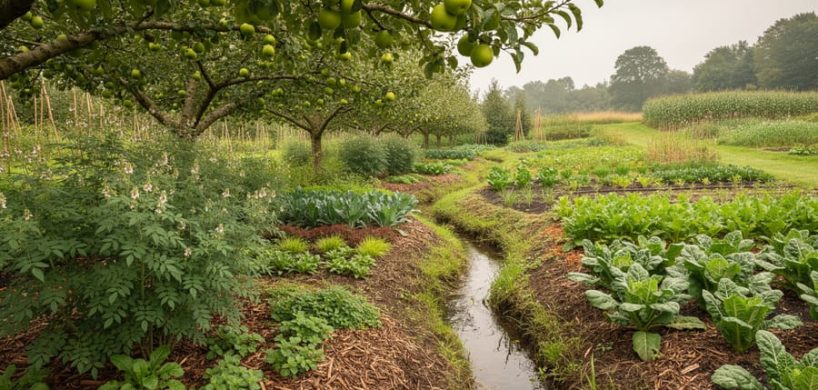
Permaculture farming is a design-based approach to agriculture that mimics natural ecosystems to create self-sustaining food production systems requiring minimal external inputs. Rather than fighting against nature with synthetic fertilizers and pesticides, permaculture works with natural patterns to build soil health, conserve water, and increase biodiversity while producing food. The method has moved from fringe concept to practical solution as conventional agriculture faces mounting pressure from climate instability, water scarcity, and soil degradation.
At its core, permaculture applies three ethics: care for the earth, care for people, and fair share of resources. These translate into tangible farming techniques like guild planting, where compatible crops support each other’s growth, and water harvesting systems that capture and distribute rainfall efficiently across the landscape. A permaculture farm might feature fruit trees underplanted with nitrogen-fixing shrubs, perennial vegetables, and ground covers that suppress weeds while building soil organic matter. The system requires upfront planning and patience but can ultimately produce more food per acre than monoculture operations while regenerating the land.
The growing interest in permaculture reflects a broader shift in how we think about food production. Farmers and homesteaders are discovering that these principles scale from backyard gardens to commercial operations, offering a viable path forward when industrial agriculture’s reliance on depleting resources becomes increasingly risky. Understanding how permaculture functions, what it can realistically achieve, and where it fits alongside other sustainable methods gives you the foundation to evaluate whether this approach matches your goals.
What Makes Permaculture Farming Different
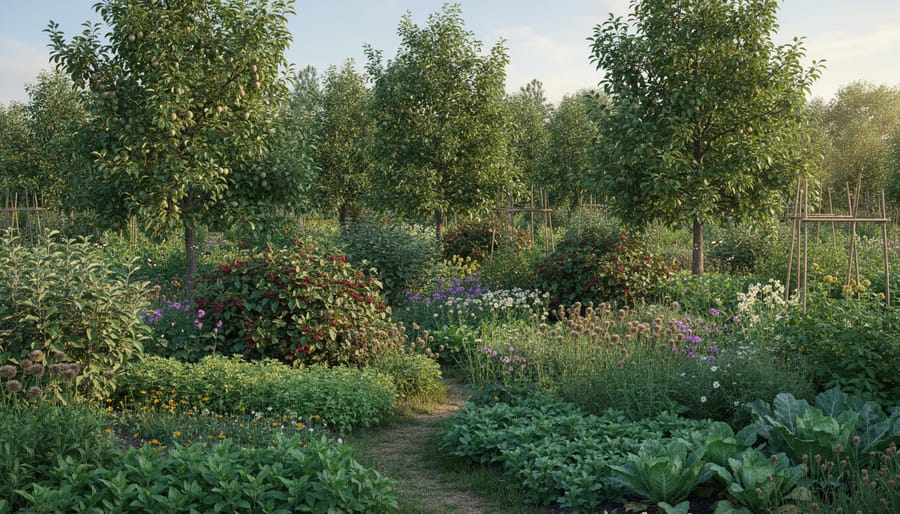
Permaculture operates from a fundamentally different philosophy than conventional agriculture. Where industrial farming views the land as a production unit to be controlled and maximized, permaculture sees it as a living system to be understood and guided. The core permaculture principles aren’t about forcing yields through external inputs, they’re about designing systems that work with natural processes to create abundance while building soil health and biodiversity.
- Observe and Interact
- Spend time watching how water flows, where sun falls, and which plants thrive before making changes. A permaculture farmer might study their land for a full year before planting major crops, noting microclimates and natural patterns that inform smarter design decisions.
- Catch and Store Energy
- Capture resources when they’re abundant for use during scarcity, whether that’s harvesting rainwater in swales, preserving summer produce for winter, or building soil organic matter that stores nutrients and carbon for future growing seasons.
- Obtain a Yield
- Systems must be productive and useful. Permaculture isn’t purely aesthetic, every element should contribute something valuable, whether food, soil improvement, wildlife habitat, or income, ensuring the system sustains both the land and the farmer.
- Apply Self-Regulation and Accept Feedback
- Design systems that self-correct rather than requiring constant intervention. If pests overwhelm a planting, that’s feedback to diversify crops, improve soil health, or introduce beneficial predators rather than reaching for chemical controls.
This design-thinking approach contrasts sharply with conventional agriculture’s reliance on tillage, synthetic fertilizers, and monocultures. While conventional farms often fight natural processes, plowing soil that wants to stay covered, applying pesticides that disrupt ecological balance, permaculture works to understand why nature does what it does and harnesses those patterns.
Vertical farming takes a different sustainability route entirely. It controls every variable in an enclosed environment, using technology to optimize growth conditions while minimizing water and space. Vertical farms excel at resource efficiency and year-round production in urban settings where land is scarce or climate is harsh.
Permaculture, by contrast, embraces variability and works primarily outdoors where soil ecosystems, weather patterns, and wild biodiversity shape outcomes. It’s slower to establish but builds regenerative capacity over time, each season leaves the land richer than before. Think of it less as a farming technique and more as ecological literacy applied to food production. The question isn’t which approach is better, but how each addresses different dimensions of sustainable agriculture in an era demanding multiple solutions.
The Growing Interest in Permaculture: Why Now
Permaculture farming has shifted from obscure agricultural philosophy to practical necessity. Climate instability, water scarcity, and depleted soils have pushed farmers and gardeners beyond conventional methods that no longer guarantee reliable yields. Where industrial agriculture depends on external inputs that grow costlier and less available, permaculture offers systems designed to function with what nature provides.
The numbers tell part of the story. Droughts persist longer, floods arrive more violently, and growing seasons become unpredictable. Farmers watching their irrigation costs spike or their topsoil wash away are discovering that permaculture’s water-harvesting swales and soil-building practices aren’t hippie idealism, they’re insurance against the next weather extreme. This isn’t about abandoning technology. Many growers now combine permaculture ground systems with vertical farming trends indoors, using each approach where it works best rather than treating them as opposing philosophies.
Educational institutions have noticed the momentum. Lost Valley Education Center runs a 12-week permaculture course starting June 27, 2026, meeting Saturdays through August 16. The sliding scale tuition ($895 to $1,295) makes serious training accessible beyond those who can afford luxury workshops, and the format lets working people attend without abandoning their current employment. Individual weekend courses cost $70, allowing newcomers to test the waters before committing to full certification.
This isn’t a fringe movement anymore. Regenerative agriculture, permaculture’s more marketable cousin, has entered mainstream farming conversations, backed by soil carbon research and watershed restoration funding. What began as counterculture experiments in the 1970s now addresses problems that conventional agriculture created but cannot solve alone. Permaculture’s time has arrived not because it won an ideological argument, but because ecological reality left fewer alternatives.
Core Permaculture Techniques That Build Resilient Food Systems
Water Wisdom: Capturing and Cycling Nature’s Most Valuable Resource
Water moves through a permaculture system the way it flows through a forest: slowly, deliberately, and multiple times before leaving. Instead of channeling rainfall off-site as quickly as possible, permaculture captures and stores it where plants can access it for months.
Swales, shallow ditches dug along contour lines, catch runoff and allow it to infiltrate rather than erode soil. The water spreads horizontally underground, hydrating tree roots and recharging groundwater tables. A properly designed swale system can turn a dry hillside into productive land without irrigation infrastructure.
Keyline design takes this further by reading the landscape’s natural water flow patterns and strategically placing features to distribute moisture across an entire property. Ponds positioned at high points gravity-feed water to lower areas. The approach maximizes each rainfall event’s value.
Greywater systems recycle household wastewater from sinks, showers, and washing machines to irrigate landscape plants. Unlike sewage, greywater contains nutrients that feed soil biology when filtered through mulch basins or constructed wetlands. What conventional systems treat as waste becomes a resource that reduces both water consumption and the environmental burden on municipal treatment facilities.
This cycling mindset directly addresses broader wastewater concerns. Rather than viewing used water as contamination requiring disposal, permaculture sees opportunities to filter, purify, and reuse it. Each gallon cycled through the system once becomes several gallons of benefit across drinking, growing food, building soil, and supporting ecosystem health.
Building Soil That Feeds Itself
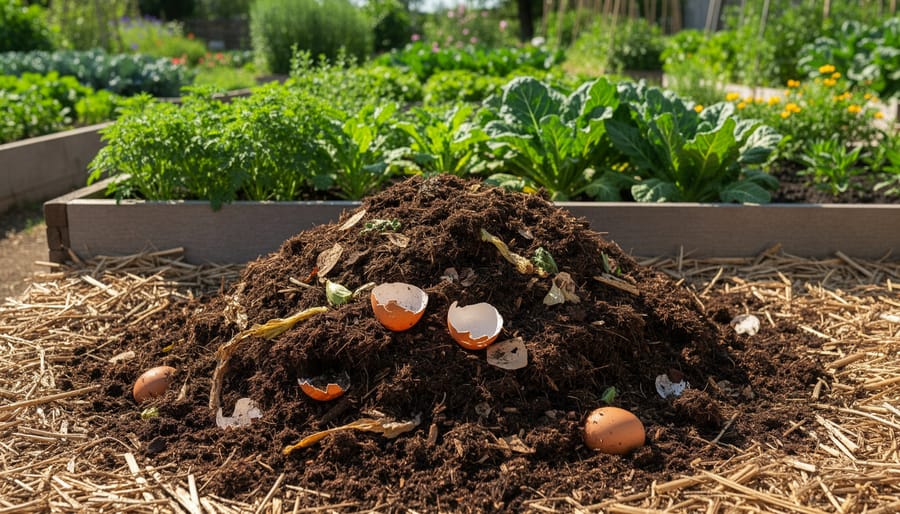
Healthy soil isn’t built, it’s grown. Permaculture approaches soil as a living ecosystem rather than an inert growing medium, creating systems where microorganisms, fungi, and organic matter work together to cycle nutrients without constant external inputs.
Composting transforms waste into fertility. Hot composting generates temperatures that break down materials quickly while killing weed seeds, producing finished compost in months. Cold composting moves slower but requires less management. Vermicomposting uses worms to convert kitchen scraps into nutrient-rich castings packed with beneficial microbes. The key is matching your composting method to available materials and time, permaculture values flexibility over rigid systems.
Mulching mimics forest floors by protecting soil with organic layers. A four to six inch blanket of wood chips, straw, or leaves suppresses weeds, retains moisture, moderates temperature swings, and feeds soil organisms as it decomposes. This approach eliminates tillage that destroys fungal networks and releases stored carbon. You’re essentially letting decomposition happen on the surface rather than forcing it underground.
Cover crops function as living mulch during off-seasons. Legumes like clover fix atmospheric nitrogen through root nodules. Deep-rooted plants break up compaction and mine nutrients from subsoil layers. When terminated before seeding, they become green manure that feeds the next crop cycle without hauling in amendments.
Mycorrhizal fungi form the soil’s nutrient internet. These microscopic networks colonize plant roots, extending their reach and trading soil minerals for plant sugars. No-till practices and diverse plantings encourage these partnerships, reducing fertilizer needs dramatically. This biological approach mirrors how arable farming reinvention focuses on soil health restoration, and how vertical farms carefully engineer growing media with beneficial microbes.
The result is soil that builds fertility through biological activity rather than chemical additions, a closed-loop system that strengthens with each growing season.
Where Permaculture and Vertical Farming Converge
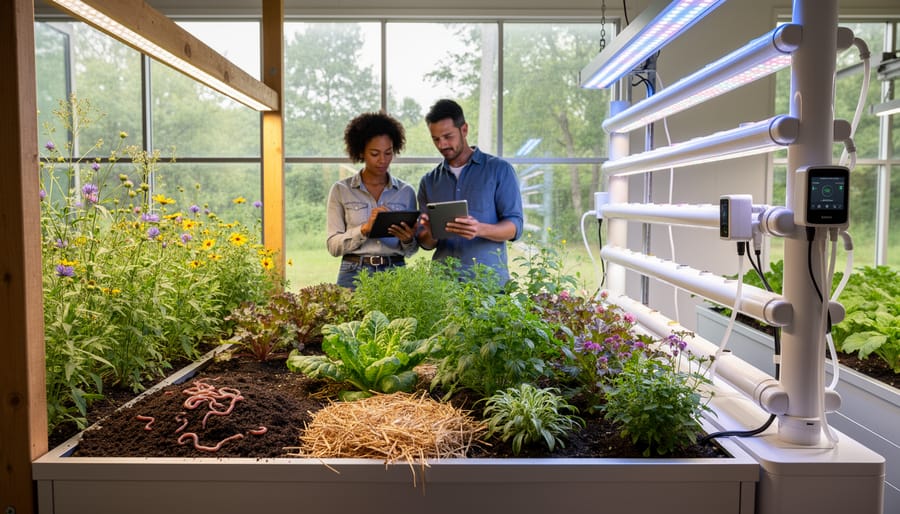
At first glance, soil-based permaculture and climate-controlled vertical farming seem like opposite ends of the agricultural spectrum. One draws from ancient wisdom and natural ecosystems, the other from LED arrays and data analytics. Yet beneath the surface, they share a fundamental philosophy: design efficient systems that minimize waste, maximize resource cycling, and produce food sustainably without depleting the environment.
The convergence happens when we view permaculture not just as a farming method but as a design framework. Its core principles translate surprisingly well into vertical operations, even when the medium shifts from earth to hydroponic channels and the sun gets replaced by precision lighting.
| Permaculture Principle | Traditional Application | Vertical Farming Translation |
|---|---|---|
| Catch and store energy | Swales, ponds, solar orientation | LED efficiency, thermal mass, energy recovery systems |
| Obtain a yield | Multi-layer food forests | Vertical stacking maximizes production per square foot |
| Use edges and value the marginal | Edge plantings, zone planning | Optimize vertical zones for different crop needs |
| Integrate rather than segregate | Companion planting, polycultures | Multi-crop systems, beneficial organism integration |
Closed-loop nutrient cycling becomes even more critical in vertical farms where inputs cost money and outputs can’t simply return to soil. Forward-thinking operators apply permaculture thinking by composting plant waste into inputs for the next cycle, cultivating beneficial microbes in growing media, and even integrating aquaponics where fish waste feeds plants. What would be “waste” in a linear system becomes feedstock in a circular one.
Integrated pest management takes interesting forms indoors. Rather than relying solely on environmental controls to exclude pests, some vertical farms introduce beneficial insects like ladybugs and parasitic wasps, mimicking the predator-prey balance that permaculture gardens cultivate outdoors. The controlled environment actually makes this easier to manage than in open fields.
Companion planting adapts too. While you won’t plant marigolds between tomato towers, vertical farmers are experimenting with strategic crop combinations on different levels. Leafy greens that prefer cooler temperatures occupy lower tiers while heat-loving crops sit near the ceiling. Aromatic herbs can deter pests from neighboring stacks, just as they would in a garden bed.
The scale differs dramatically, true. Permaculture farms work with acres and seasons. Vertical operations measure in square feet and harvest cycles. Yet both recognize that resilient food systems require working with natural processes rather than against them, whether those processes unfold in forest soil or a carefully balanced nutrient solution. The bridge between them shows that sustainable agriculture isn’t one solution but many, all pointing toward the same regenerative future.
Real-World Applications: From Backyard Gardens to Commercial Operations
Permaculture scales remarkably well, from a balcony herb spiral to a 50-acre farm, because its principles adapt to whatever space and resources you have. The design thinking matters more than the acreage.
A backyard garden offers the most accessible entry point. You might start with a simple compost system and a small guild pairing tomatoes with basil and marigolds. Over three to five years, that evolves into a layered system with perennial berries, nitrogen-fixing shrubs, and pathways that double as water-harvesting swales. The timeline reflects a core permaculture reality: you’re building an ecosystem, not installing a garden.
Urban projects demonstrate permaculture’s adaptability to constrained spaces. Rooftop gardens in dense cities use container guilds and vertical trellising to maximize productivity per square foot. Community gardens transform vacant lots into food forests with fruit trees, herb borders, and shared composting areas. These projects often integrate greywater systems that recycle sink and shower water for irrigation, turning a waste stream into a resource.
At farm scale, permaculture thinking reshapes entire operations. Commercial growers incorporate windbreaks that provide fodder and firewood while protecting crops. They design pasture rotations that mimic natural grazing patterns, improving soil health while producing meat and eggs. Some integrate permaculture zones with conventional annual crops, dedicating portions of land to regenerative systems while maintaining market-ready production elsewhere.
Businesses are borrowing permaculture principles even in unexpected contexts. Restaurants source from permaculture farms and compost food scraps back to those same operations, closing the loop. Food processors explore waste integration, feeding byproducts to livestock or composting systems rather than sending them to landfills.
The honest timeline matters: a mature food forest takes seven to ten years to reach full productivity. Early yields come from annual vegetables and quick-growing perennials, but the complex, self-maintaining system you envision requires patience. Start with one zone, learn through observation, and expand as your understanding deepens.
The Honest Challenges of Permaculture Farming
While permaculture farming offers compelling sustainability benefits, understanding its real-world constraints helps set realistic expectations. The most significant hurdle is time. Unlike conventional farming where you might see a harvest within months, establishing a mature permaculture system typically requires three to five years before perennial elements reach full productivity. During this establishment phase, you’re building soil, growing trees, and watching ecological relationships develop rather than generating immediate income.
The knowledge curve is steep. Permaculture demands understanding of plant relationships, water dynamics, soil biology, and site-specific microclimates. You can’t simply follow a recipe. Each property requires careful observation and custom design, which means either investing hundreds of hours in education or hiring experienced designers at considerable cost.
Pros
- Creates self-maintaining systems that reduce long-term labor and external inputs once established.
- Builds resilient food production that adapts to climate variability and extreme weather.
- Produces nutrient-dense food while actively regenerating soil and biodiversity.
- Reduces or eliminates dependence on synthetic fertilizers, pesticides, and fossil fuel inputs.
Cons
- Requires three to five years before perennial systems reach full productivity and income generation.
- Demands extensive knowledge of ecology, plant relationships, and site-specific design principles.
- Initial establishment involves intensive physical labor for earthworks, planting, and system building.
- Produces irregular, diverse harvests that don’t fit conventional market expectations for uniform produce.
- Scaling to commercial operations presents logistical challenges in mechanization and distribution.
Market realities present another challenge. Conventional supply chains expect uniform tomatoes and predictable harvest volumes. Permaculture systems produce diverse, seasonal yields that fluctuate based on natural cycles. This works beautifully for home gardens and community-supported agriculture models but creates friction when trying to supply grocery stores or restaurants with consistent inventory.
Scaling up from backyard to commercial operation isn’t straightforward. Many permaculture techniques are labor-intensive and resist mechanization. While a quarter-acre urban permaculture garden thrives with hand cultivation, managing twenty acres this way becomes economically challenging without hired labor or creative design solutions.
The reality is that permaculture isn’t a universal solution. It shines when integrated thoughtfully with other sustainable approaches, from high-efficiency vertical farming for leafy greens to regenerative grazing for proteins. The farmers seeing the best results in 2026 are those who view permaculture as one powerful tool in a diverse sustainability toolkit rather than an all-or-nothing philosophy.
Taking Your First Steps Into Permaculture
Starting with permaculture doesn’t require abandoning your current lifestyle or purchasing land. The most effective entry point is education paired with small-scale experimentation right where you are.
Educational pathways vary widely in commitment and cost. Individual courses focusing on specific techniques, composting, water management, or food forest design, typically run around $70 and provide targeted knowledge you can immediately apply. For deeper immersion, comprehensive programs like the 12-week Saturday course at Lost Valley Education Center (June 27 – August 16, 2026) offer structured learning at accessible sliding-scale rates ($895-$1,295), making permaculture education feasible for different budgets. Online resources, from design courses to practitioner forums, let you learn at your own pace without geographic constraints.
Before investing in plants or infrastructure, spend time observing. Watch how water moves across your space during rain. Note which areas receive full sun versus shade throughout the day. Identify existing microclimates and natural patterns. This observation phase, central to permaculture philosophy, prevents costly mistakes and reveals opportunities invisible at first glance. A month of watching teaches more than a year of fighting against your site’s natural tendencies.
Start small with a single permaculture element rather than redesigning everything at once. Transform one garden bed using sheet mulching. Install a simple rain barrel. Plant a nitrogen-fixing shrub next to a fruit tree. These modest experiments build your skills and confidence while producing tangible results that motivate further exploration.
Local permaculture groups offer invaluable support beyond what courses provide. Members share region-specific knowledge about which techniques work in your climate, connect you with plant swaps and workshares, and provide accountability as you develop your system. Search for guilds, working groups, or co-learning circles in your area, the collective wisdom of practitioners solving similar challenges accelerates your learning curve considerably.
Permaculture principles fit best when your situation allows multi-year planning and you value ecological relationships over maximum short-term yields.
The path to food security in 2026 doesn’t demand choosing between ancient wisdom and modern innovation. Permaculture farming and vertical agriculture represent two powerful approaches to the same urgent challenge: feeding people while regenerating the ecosystems that sustain us. One works with soil, seasons, and ecological succession. The other harnesses controlled environments and precision technology. Both reject the extractive mindset that depleted our farmland and strained our water supplies.
What matters isn’t which system you champion, but recognizing that resilient food systems need diverse strategies. A permaculture food forest might take years to mature, while a vertical farm can produce crops in weeks. Neither alone will solve our food security crisis, but together they offer complementary paths forward. The suburban homeowner designing a backyard guild and the entrepreneur optimizing vertical growing algorithms are working toward the same regenerative future.
If you’re ready to contribute to this shift, start exploring. Observe your own landscape and resources. Connect with local permaculture practitioners or visit innovative farms in your area. Take a weekend workshop or dive deeper into design principles. The knowledge is accessible at every price point, from free online resources to comprehensive certification programs.
The future of food isn’t just soil-based or technology-driven. It’s both, and more. What unites these approaches is the commitment to systems that give more than they take, building abundance rather than depleting it.