
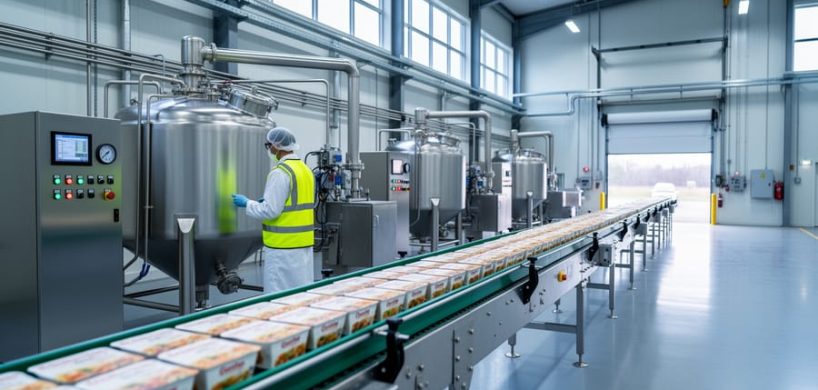
Food manufacturing is the process of turning raw agricultural ingredients, such as grains, fruits, vegetables, dairy, and meat, into finished food and beverage products that are safe, consistent, and ready to sell. It covers everything from receiving and cleaning raw materials to cooking, mixing, preserving, packaging, and quality testing. Think of it as the bridge between the field and the grocery shelf.
Understanding that bridge matters more than ever. Every stage uses energy, water, and materials, so small design choices ripple outward into cost, food safety, and environmental impact. Producers are responding with smarter sensors, heat recovery systems, and tighter inventory tracking that cut waste without sacrificing quality. Even ingredient sourcing is evolving, with methods like vertical farming which grows crops in stacked, controlled indoor layers, supplying fresh, predictable produce close to processing facilities.
This article walks through how food manufacturing works step by step, the main process types, and where each one shows up in everyday products. It also looks at the technology and sustainability gains reshaping the industry, along with the practical challenges that come with adopting them. Traditional methods still matter here too, since many of today’s best practices grew directly from them.
What Food Manufacturing Means: From Raw Ingredient to Finished Product
Food manufacturing is the set of organized, repeatable steps that turn raw ingredients into finished food products you can buy, store, and eat. It sits in the middle of the farm-to-table chain: farms grow or raise the raw materials, manufacturers transform and package them, and retailers and distributors deliver them to your kitchen.
It helps to see how this differs from the stages on either side. Farming is about producing the crop or animal product in the first place. Home cooking makes a meal for a handful of people who will eat it within hours. Food manufacturing works at a larger scale and has to deliver the same result every time, whether it makes a hundred jars or a hundred thousand. That is why it relies so heavily on consistent ingredients and carefully controlled steps.
Every food manufacturing process aims for three goals:
1. Safety: removing or controlling hazards so the food is safe to eat.
2. Consistency: delivering the same taste, texture, and nutrition from batch to batch.
3. Shelf life: keeping food fresh long enough to reach people without spoiling or going to waste.
A few core terms come up again and again in this field:
- Raw material
- Any unprocessed ingredient that enters the factory, such as harvested produce, grain, milk, or herbs.
- Processing
- The physical or chemical steps, like washing, cutting, cooking, or fermenting, that change a raw material into something new.
- Formulation
- The exact recipe, including ingredient amounts and sequence, that is scaled up for production.
- Shelf life
- The length of time a product stays safe and good quality under proper storage.
- Traceability
- The ability to follow an ingredient or product back through each step to its source.
Both traditional and industrial methods deserve credit here. Time-tested techniques like fermenting and drying are still used today, and modern equipment adds precision and scale. Together they help feed more people with less waste.
How a Food Product Moves Through the Factory
Sourcing and Receiving Ingredients
Every food product starts at the receiving dock. Before anything enters production, manufacturers check what has arrived against the specifications they ordered. Inspectors look at temperature, appearance, moisture, and packaging condition, and many facilities test samples for contaminants or spoilage. Each delivery gets a lot number so that any ingredient can be traced from the finished product back to its supplier if a problem ever surfaces.
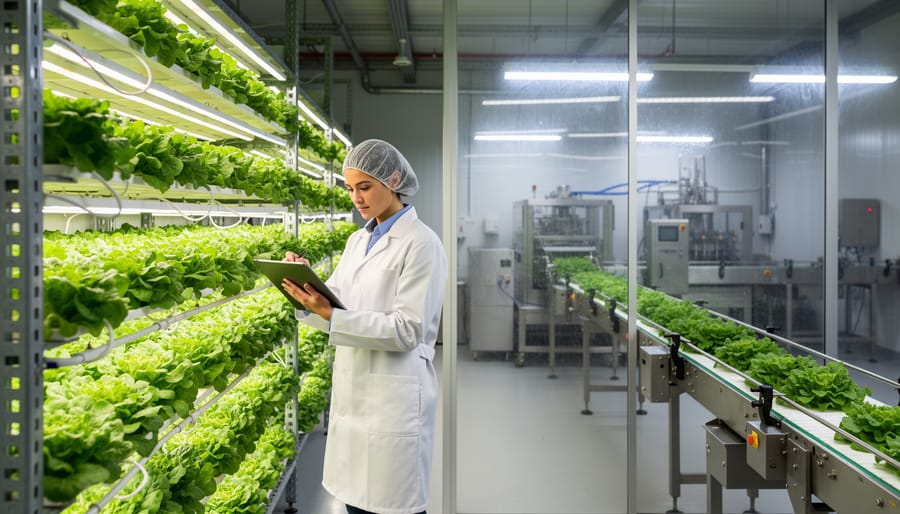
Quality at the source shapes everything downstream. Fresh, uniform ingredients need less sorting, less trimming, and less corrective processing, which means less waste and more predictable results. Produce grown in controlled environments, such as vertical farms, shows this well. Because growers manage light, water, and nutrients closely, leafy greens tend to arrive clean and consistent in size and quality, with fewer surprises for the line to handle. Starting strong makes every later step easier.
Preparation, Processing, and Formulation
Once ingredients pass inspection, they begin their transformation. Preparation usually starts with the simple stuff: washing to remove soil and residues, sorting by size, ripeness, or quality, and trimming or cutting into uniform pieces. Uniformity matters more than it sounds. Pieces that are the same size cook, cool, and freeze at the same rate, which keeps texture and safety predictable from the first batch to the thousandth.
From there, processing takes over. Depending on the product, ingredients may be blended, cooked, baked, fermented, pressed, or emulsified. Each step changes the food in a deliberate way. Cooking develops flavor and reduces microbes, while fermentation uses beneficial bacteria or yeast to build tang, depth, and natural preservation, as in yogurt or sauerkraut.
Formulation is the recipe side of the work. A kitchen recipe doesn’t simply multiply by a thousand, because heat, mixing time, and ingredient interactions behave differently at scale. Food technologists test small pilot batches first, then adjust ratios, temperatures, and timing until taste, texture, and nutritional content match the original. Sensors and standardized specifications help hold those targets steady, so the lasagna you buy in March tastes like the one you bought in October.
Preservation, Packaging, and Quality Checks
Once a product is made, the next job is keeping it safe and appealing for as long as possible. Each preservation method works by slowing the growth of microbes or the reactions that spoil food.
Heat treatment, such as pasteurization or canning, uses controlled temperatures to destroy harmful bacteria and deactivate enzymes. Sealed in an airtight container, a canned product can stay shelf-stable for years. Chilling doesn’t kill microbes, but cold temperatures slow their growth enough to buy days or weeks. Freezing goes further, pausing most biological activity so food keeps for months.
Drying and dehydration remove the water microbes need to thrive, which is why dried fruit, grains, and powders last so long. Then there’s modified-atmosphere packaging, where the air inside a sealed pack is swapped for a gas mix, often lower in oxygen. That slows browning and spoilage, which is especially handy for fresh-cut produce and salads.
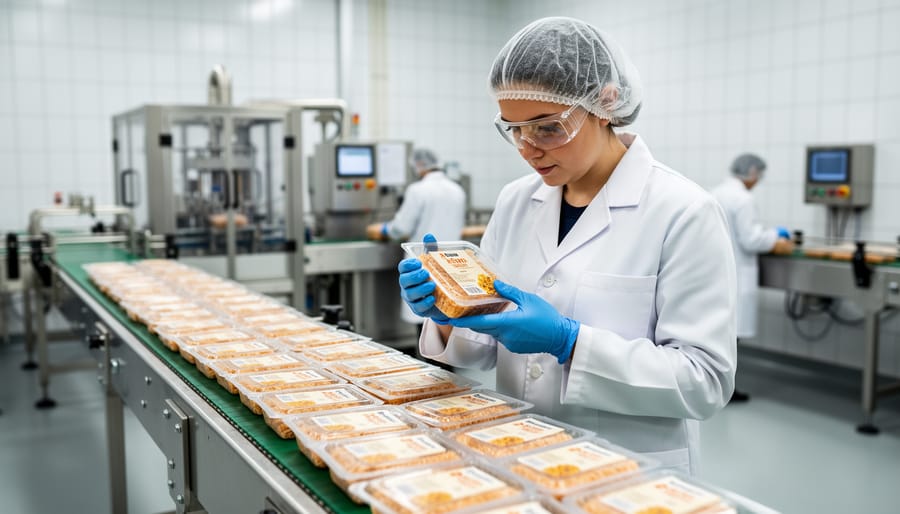
Quality checks run alongside all of this. Teams test samples for microbial counts, measure temperature and pH, check seal integrity, and scan for foreign objects with metal detectors or X-ray systems. Batches are logged and traceable, so if something looks off, it can be held back before it ships. That final verification is what turns a well-preserved product into one people can trust.
Storage and Distribution
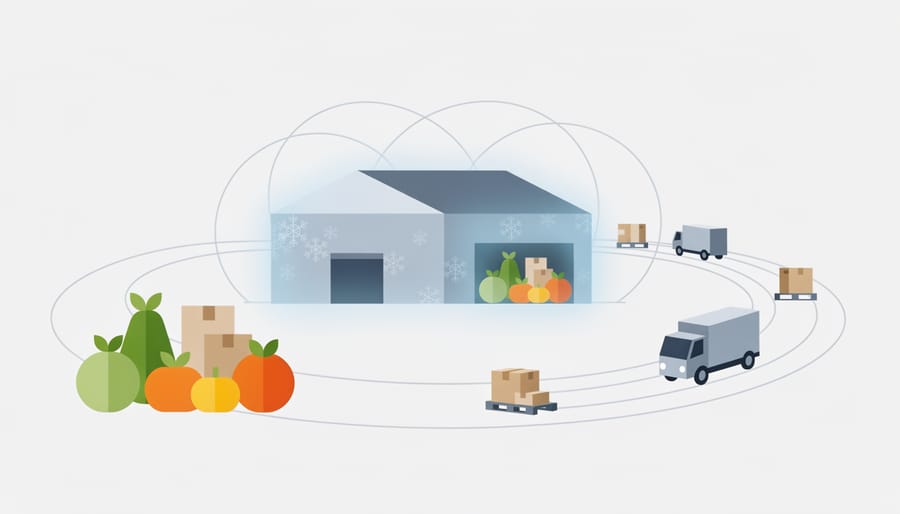
Once a product is packed and cleared, it moves into storage and distribution, where keeping the right temperature matters most. The cold chain is an unbroken series of refrigerated or frozen steps, from the warehouse to the truck to the store shelf. If it breaks, even briefly, quality drops and spoilage rises.
Warehouses track stock by batch so older products ship first, which cuts waste. Delivery routes are planned to limit time in transit.
Shorter supply chains help too. When food travels fewer miles, there’s less time for spoilage and fewer transport emissions, especially for fresh produce grown near where it’s sold.
Common Types of Food Manufacturing Processes
Not every food needs the same treatment, so manufacturers choose from a handful of process families depending on what they are making and how long it needs to last. Most plants combine several of them, and newer methods tend to complement older ones rather than replace them.
- Thermal processing uses heat to destroy harmful microbes; pasteurized milk and canned tomatoes are classic examples, and the main benefit is long, reliable shelf stability.
- Cold preservation slows spoilage through refrigeration and freezing; think chilled salads and frozen vegetables, with the benefit of keeping flavor and nutrients close to fresh.
- Drying and dehydration removes water so microbes can’t thrive; dried fruit, pasta, and powdered milk are typical, and the payoff is light, compact, easy-to-store products.
- Fermentation uses beneficial microbes to transform ingredients; yogurt, sourdough, and kimchi show how it adds flavor while naturally preserving food.
- Extrusion pushes mixtures through a shaped die under heat and pressure; breakfast cereals, snacks, and some pasta are made this way, offering consistent shapes at high volume.
- Minimally processed and fresh-cut production washes, trims, and packs produce with little alteration; bagged salad greens and cut fruit cups are common, and the benefit is convenience with a fresh taste.
Thermal processing remains the workhorse for shelf-stable goods. Pasteurization uses moderate heat to make products like milk and juice safe while preserving much of their character, while canning seals food in a container and heats it enough to keep it stable for a long time. Cold methods are gentler, which is why they suit delicate items, though they depend on an unbroken cold chain from factory to shop.
Drying and fermentation are among humanity’s oldest techniques, and they still earn their place. Modern equipment simply makes them more precise, with controlled humidity, temperature, and starter cultures that deliver repeatable results. Extrusion is a more recent industrial tool, valued for turning grains and plant proteins into many textures and shapes with relatively little waste.
Fresh-cut production is where newer thinking shines. It works best with high-quality, consistent produce, and that starts at the source. Crops grown in controlled environments, such as those using hydroponicstend to arrive clean and uniform, which can reduce washing and trimming. Gentler technologies, like modified-atmosphere packaging, then help fresh products last longer without heavy processing.
The right process is rarely about which is newest. It is about matching the method to the ingredient, the product, and the goal.
How Technology Is Making Food Manufacturing Smarter and Greener
Modern food factories are quietly becoming some of the smartest production spaces around. Sensors track temperature, humidity, pH, and flow rates in real time, so a drifting cooker or a warming cold room gets flagged within minutes instead of at the end of a shift. Machine learning models spot patterns humans might miss, like a slight color shift on a sorting line that hints at an ingredient problem. Catching issues early means fewer rejected batches and more consistent products.
Automation helps with consistency too. Robotic arms portion, pack, and palletize with steady precision, and vision systems inspect every item rather than a sample. The result is less rework and less food headed for the bin.
Resource use is improving alongside quality. Heat recovery systems capture waste heat from ovens and pasteurizers and put it to work elsewhere in the plant. Variable-speed motors and smart scheduling trim electricity demand. On the water side, many facilities now treat wastewater on-site and reuse it for tasks like initial rinsing or cooling, always within food safety rules. Better portioning and right-sized packaging also cut materials, while demand forecasting helps producers make closer to what will actually sell.
Of course, these gains aren’t free. Upfront equipment costs can be significant, especially for smaller producers. Some technologies, like advanced refrigeration or water treatment, add their own energy demand, which is why pairing upgrades with renewable power or heat recovery matters. Teams also need training to interpret data and maintain connected equipment, and older plants may need careful integration work.
The thinking behind all this will feel familiar to anyone following precision indoor agriculture. Vertical farms use sensors and data to give crops exactly the light, water, and nutrients they need, and recirculate resources instead of wasting them. Food manufacturing is applying the same principle further down the supply chain: measure closely, adjust quickly, and keep every input working as long as possible.
Where Food Manufacturing Processes Are Used
Food manufacturing shows up in nearly every aisle of the grocery store, and the same core steps (receiving, preparing, preserving, packaging, and testing) adapt to each product category.
Packaged produce and salads rely on gentle washing, sorting, fresh-cut preparation, and modified-atmosphere packaging to keep leafy greens crisp. Dairy plants use pasteurization and cold storage to turn raw milk into yogurt, cheese, and butter. Bakeries scale up recipes through mixing, proofing, and baking, while beverage makers focus on blending, heat treatment, and filling lines that protect flavor. Ready meals combine many of these steps at once, cooking and chilling components before they’re assembled into a single tray.
Many facilities also supply ingredients rather than finished goods, such as flours, purées, dried fruit, and fermented bases that other manufacturers turn into their own products. The scale changes, but the logic doesn’t. A small artisan producer may batch-process by hand with simple equipment, while a large plant runs automated lines with inline sensors. Both depend on traceable sourcing, clean handling, and documented quality checks.
That consistency is also where opportunity lies. Businesses that map their process clearly can meet safety standards more easily and answer shoppers’ growing questions about where food comes from. Short, local supply chains help here too, especially as urban agriculture brings fresh ingredients closer to the facilities that process them. Clear labeling and open communication about methods turn good manufacturing practice into something customers can actually see and trust.
Food Manufacturing Process FAQs
Is processed food always unhealthy?
No. “Processed” covers everything from frozen vegetables and canned beans to sugary snacks, and nutrition varies widely across that range. Frozen, canned, and fermented foods can be nutritious, while heavily formulated products may be high in added sugar, salt, or fat, so the ingredient list and nutrition label are better guides than the word “processed” alone.
What is the difference between food processing and food manufacturing?
The two terms overlap, and people often use them interchangeably. Food processing usually refers to the individual techniques applied to ingredients, such as washing, cooking, or freezing, while food manufacturing describes the whole organized system that combines those steps to produce a finished, packaged product at scale.
How is food safety ensured during manufacturing?
Facilities build safety into every stage, from inspecting incoming ingredients to controlled heat or chilling steps, hygiene protocols, and testing before products ship. Many follow a hazard analysis approach, identifying where risks could arise and monitoring those points, and most are subject to regulatory inspection.
Can fresh produce be part of a manufactured product line?
Yes. Packaged salads, fresh-cut vegetables, and herbs are all manufactured in a sense, since they are washed, sorted, cut, and packed under controlled conditions. Consistent, clean ingredients from controlled-environment growing can make these lines simpler to run and reduce waste along the way.
Environmental impact is a fair question too, and the answer depends on how a facility is run. Water and energy use, packaging, and food waste all matter, but better sensors, wastewater reuse, and shorter supply chains are steadily shrinking that footprint across the industry.
The food manufacturing process is, at its core, a chain of careful decisions that turns raw ingredients into food people can trust. Sourcing sets the quality ceiling, preparation and formulation shape taste and nutrition, preservation and packaging protect safety and shelf life, and storage and distribution get the finished product to the table in good condition. Skip or rush any one stage, and the others have to work harder to compensate.
What makes this field exciting right now is how quickly it’s improving. Sensors and automation catch problems early, smarter water and energy use trims the footprint of every batch, and cleaner packaging cuts waste. Better ingredient sourcing, including fresh produce grown in controlled environments, gives manufacturers a consistent starting point. Add growing transparency, so shoppers can see where their food came from and how it was made, and the whole system becomes more resilient. That’s a promising path toward stronger food security and more responsible stewardship of the planet.