
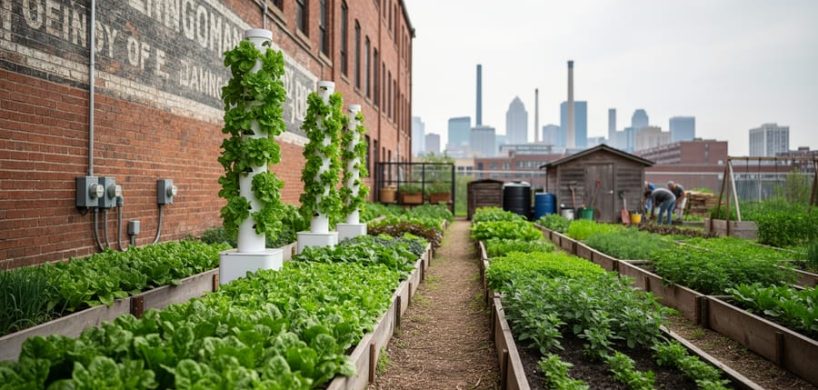
Detroit has emerged as the nation’s most recognized model for urban agriculture, transforming nearly 1,400 acres of vacant land into productive farms, gardens, and green infrastructure that feed thousands of residents while creating economic opportunity in neighborhoods once defined by abandonment. What is urban agriculture? In Detroit, it’s a multifaceted movement encompassing everything from small backyard plots managed by individual families to commercial-scale operations producing specialty crops for restaurants, alongside community gardens that anchor neighborhood revitalization efforts.
The city’s landscape of farming reflects both grassroots determination and technological innovation. Organizations like Keep Growing Detroit support over 1,800 urban gardens through seed distribution and education programs, while newer ventures integrate hydroponic systems and sensor-based irrigation to maximize yields in spaces ranging from reimagined parking lots to converted warehouses. This blend of traditional soil-based growing and advanced controlled-environment agriculture positions Detroit as a laboratory for sustainable food systems.
What makes Detroit’s experience particularly relevant is its replicability. Cities worldwide face similar challenges: food deserts, underutilized land, unemployment, and the need for climate-resilient local food sources. Detroit’s approach demonstrates how urban agriculture addresses these interconnected problems simultaneously, creating measurable improvements in food access, environmental quality, and community cohesion. The lessons emerging from Detroit’s two-decade experiment offer practical frameworks for municipalities ready to view vacant land not as liability but as agricultural potential.
Detroit’s Urban Agriculture Journey: From Abandonment to Agricultural Innovation
Detroit’s transformation from industrial powerhouse to agricultural innovator began with catastrophic collapse. When the automotive industry contracted in the 1980s and 1990s, Detroit lost more than half its population, dropping from 1.8 million residents in 1950 to fewer than 700,000 by 2010. Entire neighborhoods emptied. Factories closed. What remained was roughly 40 square miles of vacant land an area larger than San Francisco, scattered across the city in abandoned lots, demolished building sites, and formerly vibrant blocks now reclaimed by weeds.
Residents didn’t wait for a recovery plan. In the early 1980s, families began planting gardens on empty lots simply to feed themselves. These weren’t aspirational lifestyle projects; they were survival strategies in a city where grocery stores had fled along with the jobs. Neighbors shared seeds, tools, and knowledge passed down from relatives who’d migrated from the rural South. What started as scattered household gardens gradually evolved into organized community plots.
By the 2000s, this grassroots movement had matured into something more ambitious. The Greening of Detroit, founded in 1989, began coordinating resources and training programs. Detroit Black Community Food Security Network launched D-Town Farm in 2008, demonstrating that urban agriculture could address both nutrition and economic development. Small commercial operations emerged, supplying restaurants and farmers markets with locally grown produce.
Today’s landscape represents a fundamental reimagining of what cities can be. The network includes large-scale commercial farms using sustainable practices, tech-enabled operations experimenting with hydroponics and vertical systems, and hundreds of neighborhood gardens managed by residents who view food production as community building. Detroit proved that devastation could become opportunity, that cities didn’t need to follow a single path back from industrial decline.
The Current Landscape: Types of Urban Agriculture Thriving in Detroit
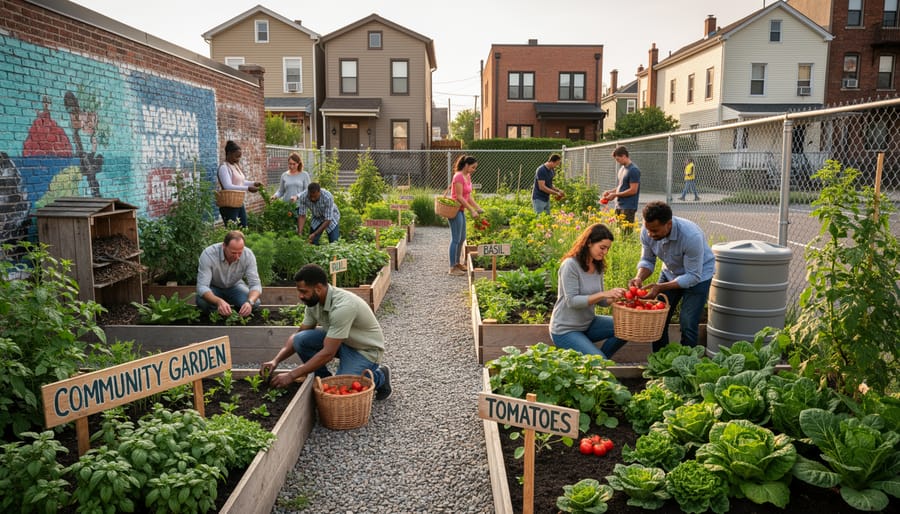
Community Gardens and Neighborhood Food Hubs
Community gardens represent the most widespread form of urban agriculture in Detroit, with over 1,900 registered gardens scattered across every neighborhood. These resident-managed plots typically range from 2,000 to 10,000 square feet and operate on a simple premise: neighbors collectively transform vacant lots into productive green spaces where they grow vegetables, herbs, and fruit primarily for personal consumption and sharing.
What makes these gardens especially valuable isn’t just the food production. They function as neighborhood anchors where residents gather to work, exchange gardening knowledge, and build social bonds that strengthen community fabric. In areas where commercial disinvestment has eliminated gathering places, gardens create vital social infrastructure.
The accessibility model matters too. Most gardens operate with minimal barriers to entry, no membership fees, flexible time commitments, and shared tool libraries mean participation doesn’t require financial resources or prior experience. Older residents teach newer gardeners traditional growing techniques, creating intergenerational knowledge transfer that preserves both agricultural skills and community memory.
These grassroots spaces also address immediate needs beyond food. They provide safe outdoor recreation areas for children, improve mental health through purposeful outdoor activity, and give residents direct control over at least one aspect of their environment in neighborhoods that often lack agency over larger development decisions.
Commercial Urban Farms
Detroit’s commercial urban farms operate at scales ranging from quarter-acre intensive plots to multi-acre operations, serving diverse market channels. Michigan Urban Farming Initiative runs a three-acre production farm that supplies restaurants and participates in Community Supported Agriculture programs, demonstrating how abandoned parcels can generate revenue while building neighborhood connections. Keep Growing Detroit coordinates a network of smaller growers who aggregate produce for wholesale buyers, solving the distribution challenge that individual farmers face alone.
Business models reflect pragmatic adaptation to Detroit’s specific conditions. Many successful operations combine direct-to-consumer sales through farmers markets with wholesale contracts, maintaining cash flow stability while building customer relationships. Season extension infrastructure, hoop houses and cold frames, stretches the growing calendar from April through November, improving financial viability in Michigan’s climate.
Economic sustainability requires realistic assessment. Most farms operate on tight margins, with revenue per acre typically ranging from $15,000 to $40,000 depending on crop selection and market access. Farmers leverage low land costs and high urban demand for locally grown produce, but labor intensity and infrastructure investment remain genuine constraints. The most resilient operations diversify income through farm stands, value-added products, and educational programming rather than relying solely on crop sales.
Emerging Tech-Enabled Farming Solutions
Detroit’s tech-enabled farming sector demonstrates that what is vertical farming looks like in practice, with operations converting former industrial buildings into year-round production facilities. These controlled environment agriculture systems use LED grow lights, climate control, and recirculating hydroponic systems to produce leafy greens and herbs regardless of Michigan’s harsh winters. Startups and social enterprises are experimenting with hybrid approaches that merge natural farming with hydroponics seeking to balance technological efficiency with biological soil health principles.
The appeal in Detroit goes beyond novelty: vertical farms can operate in abandoned warehouses close to customers, slashing food miles and delivery times. They require less water than field farming and eliminate pesticide use entirely. While capital costs remain significant, several operations have demonstrated commercial viability by targeting high-value crops and restaurant partnerships, proving that technology-driven agriculture can coexist with community gardens to serve different market needs.
Environmental and Sustainability Impact
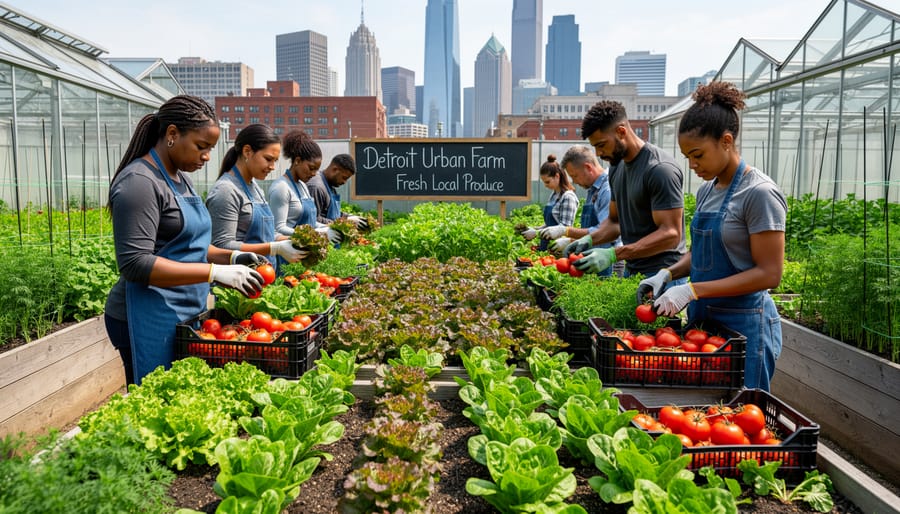
Detroit’s urban agriculture network generates measurable environmental benefits that extend far beyond food production. The city’s 1,400+ farms and gardens function as distributed green infrastructure, transforming previously impermeable surfaces into living systems that actively improve ecological conditions.
Stormwater management represents one of the most significant impacts. Every acre of urban farmland absorbs roughly 20,000 to 50,000 gallons of rainwater during major storm events, reducing the burden on Detroit’s aging combined sewer system. This natural filtration prevents contaminated overflow from reaching the Detroit River and Lake St. Clair. Gardens with rain gardens, bioswales, and compost-enriched soil perform even better, capturing runoff that would otherwise carry petrochemicals and heavy metals from roads into waterways.
Soil remediation happens gradually but substantially. Detroit’s agricultural sites employ phytoremediation, using plants like sunflowers and certain grasses to extract lead and other industrial contaminants from soil. After several growing seasons, contaminated plots show measurably reduced toxin levels. Many farms also build raised beds with clean soil, effectively capping polluted ground while creating productive growing space. The addition of organic matter through composting rebuilds soil structure depleted by decades of neglect.
Biodiversity flourishes in these green spaces. Urban farms create habitat corridors for pollinators, with native wildflowers and diverse crop plantings supporting bee and butterfly populations that had nearly disappeared from industrial neighborhoods. Bird species have rebounded as these sites provide nesting areas and food sources. This ecological diversity strengthens resilience against pests and diseases while reconnecting urban residents with natural systems.
Urban heat island reduction occurs through vegetation’s cooling effect. Farmed lots register 10-15°F cooler than adjacent concrete or asphalt surfaces during summer months. This localized cooling reduces energy demands for nearby buildings and improves air quality by lowering ground-level ozone formation.
Carbon sequestration, while modest per site, becomes significant at scale. Detroit’s urban agriculture sector collectively captures an estimated 2,000+ tons of carbon annually through plant growth and soil organic matter accumulation. When combined with year-round indoor growing technologies that reduce food transportation distances, the city’s diversified agriculture system demonstrates how local production can meaningfully contribute to climate mitigation goals while delivering immediate community benefits.
Addressing Food Security and Community Health
Detroit’s urban agriculture movement addresses a stark reality: nearly one-third of city residents live in areas classified as food deserts, where fresh, affordable produce is difficult to access. The agricultural transformation has directly responded to this crisis by placing food production within walking distance of homes in neighborhoods long neglected by conventional grocery retailers.
The health implications of improved produce access are measurable. Research tracking Detroit neighborhoods with established urban farms and gardens shows residents increase their vegetable consumption by an average of two additional servings per week. This shift matters in a city where diet-related diseases like diabetes and hypertension disproportionately affect low-income communities. When families can harvest tomatoes, greens, and peppers from gardens three blocks away rather than traveling miles to a supermarket, the barriers to healthy eating diminish.
Beyond nutrition, urban agriculture strengthens community health through physical activity and social connection. Gardening provides moderate exercise while reducing the social isolation that plagues post-industrial neighborhoods with high vacancy rates. Multi-generational farm spaces have become gathering points that rebuild neighborhood cohesion.
The concept of food sovereignty, communities controlling their own food systems rather than depending on distant supply chains, runs deep in Detroit’s agricultural identity. Residents who experienced food access failures during the 2008 recession and again during pandemic disruptions recognize that local production offers resilience against external shocks. This self-determination extends to cultural food preferences; urban farms grow collard greens, okra, and other vegetables central to the African American culinary tradition that dominates many Detroit neighborhoods, foods often absent from the limited selections in corner stores.
Technology-enhanced growing systems complement this grassroots food security work by enabling year-round production in Michigan’s harsh climate. Controlled environment agriculture extends the harvest season beyond the traditional May-to-October window, maintaining consistent fresh food availability during winter months when nutritional gaps typically widen in low-income households.
Infrastructure and Support Systems Enabling Growth
Detroit’s urban agriculture success stems not from a single initiative but from an interconnected web of support systems that lower barriers to entry and sustain long-term operations. This infrastructure demonstrates how cities can deliberately foster agricultural development through coordination rather than central control.
The Keep Growing Detroit coalition anchors the nonprofit ecosystem, distributing seeds, providing technical assistance, and operating a garden resource program that’s served over 1,600 gardens since 2013. They’ve established a model where farmers access shared equipment, composting services, and market connections without requiring upfront capital investment.
Municipal policy evolved to match the sector’s growth. Detroit’s 2013 urban agriculture ordinance created clear pathways for commercial farming on vacant lots while the city’s GreenWays initiative prioritizes water infrastructure improvements in agricultural zones. The Planning Department now maintains a dedicated urban agriculture coordinator position, embedding food production into neighborhood development strategies rather than treating it as a temporary land use.
| Organization/Program | Core Services | Reach |
|---|---|---|
| Keep Growing Detroit | Seeds, tools, education, market access | 1,600+ gardens |
| Michigan Urban Farming Initiative | Land development, technical training | 300+ trained farmers |
| City Water Affordability Program | Subsidized irrigation access | 200+ agricultural sites |
| Detroit Food Policy Council | Advocacy, systems coordination | Citywide policy impact |
Water access programs deserve particular attention. The city negotiated discounted commercial rates for farms meeting production thresholds, directly addressing what had been the highest operational expense for many growers. Educational infrastructure includes Michigan State University Extension workshops, Wayne State University’s urban agriculture certificate program, and peer-to-peer learning networks facilitated through neighborhood hubs.
This layered support structure proves replicable. Cities don’t need massive budgets; they need coordination between existing institutions, policy frameworks that recognize agriculture as legitimate urban land use, and modest investments in shared resources that reduce individual risk.
Challenges and Pragmatic Solutions
Detroit’s urban agriculture success doesn’t mean the challenges have vanished. Land tenure remains precarious for many growers, farms operating on vacant lots often lack formal ownership or long-term leases, creating hesitation around infrastructure investment. The Detroit Land Bank Authority has begun establishing side-lot programs and affordable land transfers, giving established farms pathways to ownership that stabilize operations.
Soil contamination poses another persistent hurdle. Decades of industrial activity left heavy metals and petroleum residues in many parcels. Rather than abandoning these sites, Detroit farmers employ phytoremediation using plants like sunflowers to extract contaminants, build raised beds with clean soil, or conduct thorough testing before planting. Some operations have shifted toward controlled environment systems that eliminate soil contact entirely, applying practical indoor growing tips to produce clean food regardless of ground conditions.
Water access and cost create economic strain, particularly for commercial operations requiring irrigation. Detroit’s aging infrastructure means high water rates that cut into farm profitability. Growers respond with rainwater harvesting systems, drip irrigation that minimizes waste, and advocacy for agricultural water rate structures similar to those in other cities. Some have formed cooperatives to share equipment costs and negotiate bulk purchasing.
Michigan’s short growing season limits outdoor production to roughly five months, constraining revenue potential. Year-round greenhouse operations and indoor vertical farms address this gap, though startup costs remain steep. Collaborative models are emerging where established outdoor farms partner with controlled environment operations, diversifying production calendars and risk.
Economic sustainability requires farms to move beyond mere production toward value-added processing, CSA programs, and direct institutional sales to schools and hospitals. Business training programs through organizations like Keep Growing Detroit help farmers develop financial management skills alongside agricultural expertise, building operations that thrive rather than merely survive.
What Other Cities Can Learn from Detroit’s Model
Detroit’s transformation offers a blueprint that extends far beyond its specific circumstances. Cities facing vacant land, food access gaps, or post-industrial decline can adapt several core strategies while respecting their unique contexts.
Start with what you have. Detroit didn’t wait for perfect conditions or comprehensive plans. Residents identified unused spaces and began growing food, creating momentum that later attracted policy support and investment. Cities can replicate this bottom-up approach by mapping underutilized land, vacant lots, unused school grounds, closed industrial sites, and streamlining permitting for temporary agricultural use. The key is lowering barriers to entry rather than designing elaborate systems before planting begins.
Community ownership drives longevity. Detroit’s most resilient projects involve residents from conception through harvest, not outside organizations imposing solutions. Successful replication requires investing time in neighborhood listening sessions, supporting resident-led initiatives with technical assistance rather than top-down programs, and building local leadership capacity. The farms that endure are those where communities see themselves reflected in decision-making.
Embrace hybrid systems that combine traditional outdoor farming with technology-enabled solutions. Detroit demonstrates that community gardens addressing social needs and controlled environment agriculture tackling year-round production aren’t competing models, they’re complementary. Cities should support both: accessible outdoor spaces for community engagement and climate-resilient indoor systems for consistent supply. This diversity strengthens food security more than any single approach.
Address land tenure proactively. Detroit’s lingering uncertainty around property ownership has hampered investment and expansion. Cities can establish land banking programs, create agricultural easements, or offer long-term leases that give farmers confidence to invest in soil building and infrastructure. Clear pathways to land access accelerate growth dramatically.
Build water infrastructure and soil testing programs early. These unglamorous foundations determine which projects survive. Municipal support for affordable water access and contamination assessment removes critical barriers that individual farmers can’t overcome alone.
Can Detroit’s approach work in denser cities with less vacant land?
Absolutely. While Detroit’s abundance of open space allows extensive outdoor farming, denser cities can emphasize rooftop gardens, vertical farming systems, and underutilized institutional spaces. The core principles, community engagement, adaptive reuse, and hybrid farming models, translate regardless of available acreage.
What initial investments are needed to start urban agriculture programs?
Grassroots efforts can begin with minimal investment, basic tools, seeds, and volunteer labor. More substantial initiatives requiring water infrastructure, soil remediation, or controlled environment technology typically need $50,000, $500,000+ depending on scale. Many cities phase investments, starting small and expanding as projects demonstrate impact.
How long before urban agriculture becomes economically self-sustaining?
Community gardens focused on social benefits may never be fully self-funding, nor should they be. Commercial farms typically need 3-5 years to reach profitability. Technology-enabled operations often require longer timelines but can achieve year-round revenue streams that traditional farms can’t.
What role does technology play versus traditional outdoor farming methods?
Both are essential. Traditional methods provide community connection, lower barriers to entry, and ecological benefits like stormwater management. Technology enables climate-resilient production, extends growing seasons, and addresses food security more reliably. Successful cities integrate both rather than choosing one.
The most important lesson isn’t replicating Detroit’s specific projects but adopting its experimental mindset. The city became a leader by trying approaches, learning from failures, and adapting quickly. Other cities should view urban agriculture as an evolving practice requiring iteration, not a fixed model to copy exactly.
Detroit’s urban agriculture story offers more than inspiration, it provides a working blueprint for cities confronting similar challenges. The transformation from industrial ruin to productive farmland demonstrates how communities can reclaim their food security while addressing environmental restoration simultaneously.
What makes Detroit’s model particularly valuable is its hybrid approach. Community-led outdoor farms and gardens preserve cultural connections to land while building neighborhood solidarity. Meanwhile, technology-driven controlled environment operations extend growing seasons, maximize space efficiency, and reduce resource consumption. Neither approach alone would have created the resilient food system Detroit now enjoys. Together, they form complementary layers that buffer against supply disruptions, weather extremes, and economic shocks.
The scalability question matters less than adaptability. Cities won’t copy Detroit’s exact blueprint, they’ll extract principles that fit their local context. A coastal city might integrate aquaponics more heavily. A southwestern community could combine solar infrastructure with vertical farms. The core lesson remains consistent: treat vacant or underutilized urban land as opportunity rather than liability.
Climate change will intensify pressure on traditional agricultural systems. Detroit’s experience shows that urban food production, when designed for both community access and technological efficiency, creates adaptable systems that grow stronger under stress. The city didn’t just survive its crisis, it pioneered solutions that other communities will increasingly need.